top of page

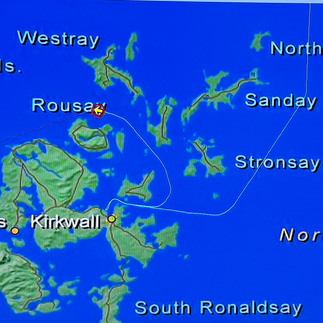
Kirkwall is the largest town of the Orkney Islands, situated on an isthmus (I always wanted to use that word!) across from Scapa Flow, a huge natural harbor that was the Royal Navy base of operations during both world wars. Being something of a student of history, I had always wanted to see Scapa Flow for myself and now would get my chance.


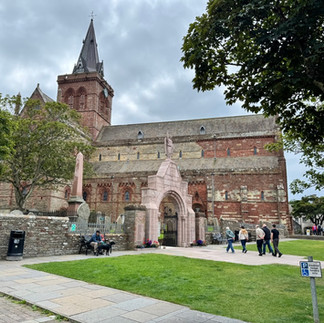
We started the day exploring Kirkwall on our own. It is a charming town with many stone built buildings from across the ages.


In the afternoon we took an excursion called "Orkney's Archeological Wonders". Orkney has two impressive sites of ancient standing stones from the same Neolithic period as Stonehenge. There is also an excavated village, Skara Brae, from that period. From Skara Brae we could see a lovely curving beach where brave locals were cavorting in the waves, despite a water temperature of 56F that day. Did I mention that the people of these islands north of Scotland are tough?


The tour also took us along the coast line with views of Scapa Flow. It was great to see that huge harbor up close and hear the stories of its history from our guide, but no photos would do it justice. Scapa Flow has quite the history of wrecks and disasters as chronicled here.


We would like to come back to Kirkwall and explore more of Orkney.


This was our second stop in the Faroes. Tórshavn is the capital and largest city of the Faroes, located on Streymoy Island, with a population of 22,000. Tórshavn has had a human population since the Vikings settled it in the 800s. As you can see from the first photo below, Tórshavn has a picturesque and colorful harbor.


Once again we selected a hike for our excursion. We road a bus north to a hillside with views of the Kaldbak fjord. Then the bus stopped at the side of the road and the guide led us up the grassy hillside, where no track was visible. As we climbed over the first ridge the views opened up and we saw ahead a volcanic mountain with a lot of exposed basalt. Most of us completed the climb, but one group turned back about half way. It was definitely worth the climb. The Faroes abound in natural beauty. And with all the good food on the cruise ship, it was good to get in some exercise!


Growing up in England, I had heard of the Faroe Islands and never thought I would visit. When we learned about this cruise, it was the stops in the Faroes and the Orkneys that immediately attracted us.


Klaksvík is the second largest town of the Faroe Islands, on the island of Borðoy, with a population of just 5,000. The main industry is fishing, but tourism is picking up. Klaksvik used to be quite isolated from the rest of the Faroes, until the Norðoyatunnilin sub-sea tunnel was built in 2006 linking it to Tórshavn, the capital, and our next stop on the cruise.


For our excursion we went on a hike up Mount Klakkur, a 1400 foot peak just outside of Klaksvik, with amazing views. The hike was not particularly steep, but the guide set a punishing pace, making us realize that you have to grow up tough in the Faroes.


bottom of page